A complete examination management system that implements the PARAKH 7-step framework — from assessment design and blueprint creation to question writing, paper assembly, and secure printing. Supports AI-powered and manual generation in 16 languages.
PARAKH's study of question papers across Indian school boards identified critical gaps that undermine educational equity and assessment validity.
Marks are not aligned to the cognitive demands of content, leading to papers that fail to accurately measure student learning across different abilities.
No systematic approach to distributing marks across objective, short answer, and long answer questions relative to their difficulty levels and content weight.
Without structured blueprints, paper setters create assessments that vary widely in content coverage, ability testing, and difficulty — compromising equivalence across boards.
PARAKH ITMS solves this by digitising the complete PARAKH 7-step framework — ensuring every question paper is balanced across abilities (Awareness, Sensitivity, Creativity), content areas, question types, and difficulty levels, with full blueprint traceability.
PARAKH ITMS implements each step from the official "Guidelines for Setting Balanced Question Papers to Promote Equivalence in Assessment Practices of School Boards."
A dedicated module to create cadres, assign credentials, and grant permissions per subject — so every user only sees the parts of the system they're authorised to work with.
Admins create cadres directly from the dashboard, set a secure password, and bind each cadre to a specific subject. Access permissions follow automatically based on the cadre's assigned role.
Add a new user with cadre name, password, and subject assignment in a single form.
Each cadre is locked to its subject — no cross-subject access without explicit reassignment.
Browse all created cadres with filters by subject and status from the View Cadres screen.
Question Bank, Paper Blueprint, Generation, and Print modules unlock based on cadre role.
Each role unlocks a specific set of modules within the system.
Full system access — manages cadres, subjects, and global settings.
Creates and tags questions in the Question Bank for assigned subject only.
Reviews, approves, or rejects submitted questions before they enter the bank.
Accesses Secure Paper Print module for final paper generation and dispatch.
The PARAKH guidelines define three primary abilities that every question must assess. Our system enforces this mapping at the point of question creation, ensuring no question enters the bank without proper classification.
Questions testing factual recall, conceptual understanding, and procedural fluency
Questions testing interpersonal skills, ethical reasoning, and collaborative thinking
Questions testing higher-order thinking, innovation, and original application of concepts
A differentiated learning model that lets every student meet core competencies while giving the curious and the gifted a structured path to go further — in the same classroom, with the same curriculum.
Required for all students. Establishes the foundation every learner must reach.
For students with deeper interest who want to move beyond the procedural.
A standard paper for everyone, plus an optional advanced paper for those who opt in.
One shared construct across both levels, with extensions for advanced learners.
The aim of assessment must shift from one that primarily tests rote memorisation to one that is more formative, competency-based, and tests higher-order skills such as analysis, critical thinking, and conceptual clarity.
— National Education Policy 2020
From building a competency-mapped question bank to generating balanced papers in 16 languages — AI-powered and manual, all in one system.
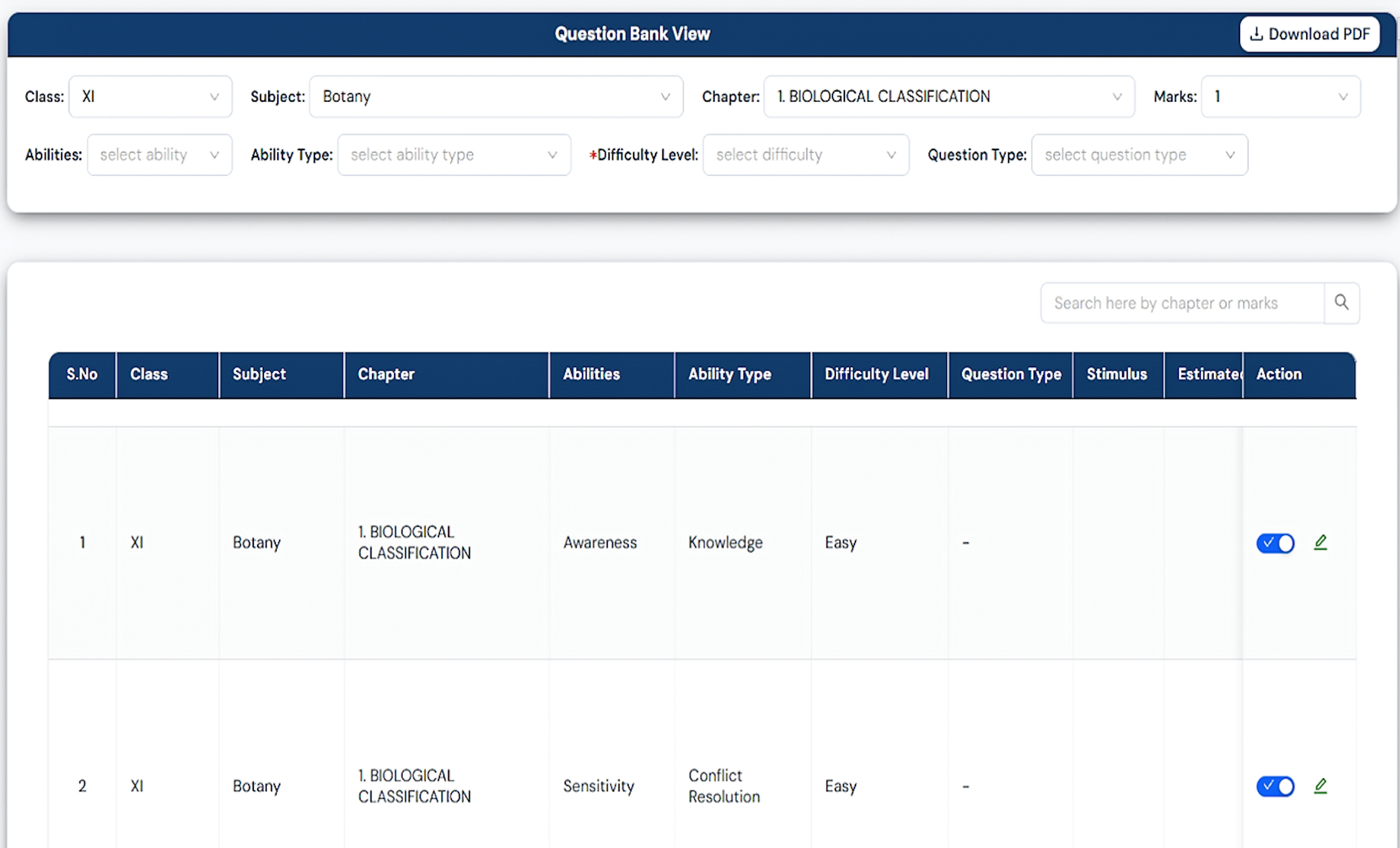
Create and manage questions with PARAKH-defined ability categories (Awareness, Sensitivity, Creativity), sub-abilities, three difficulty levels, competency codes, estimated answering time, and stimulus material — authored simultaneously in multiple languages with live preview.
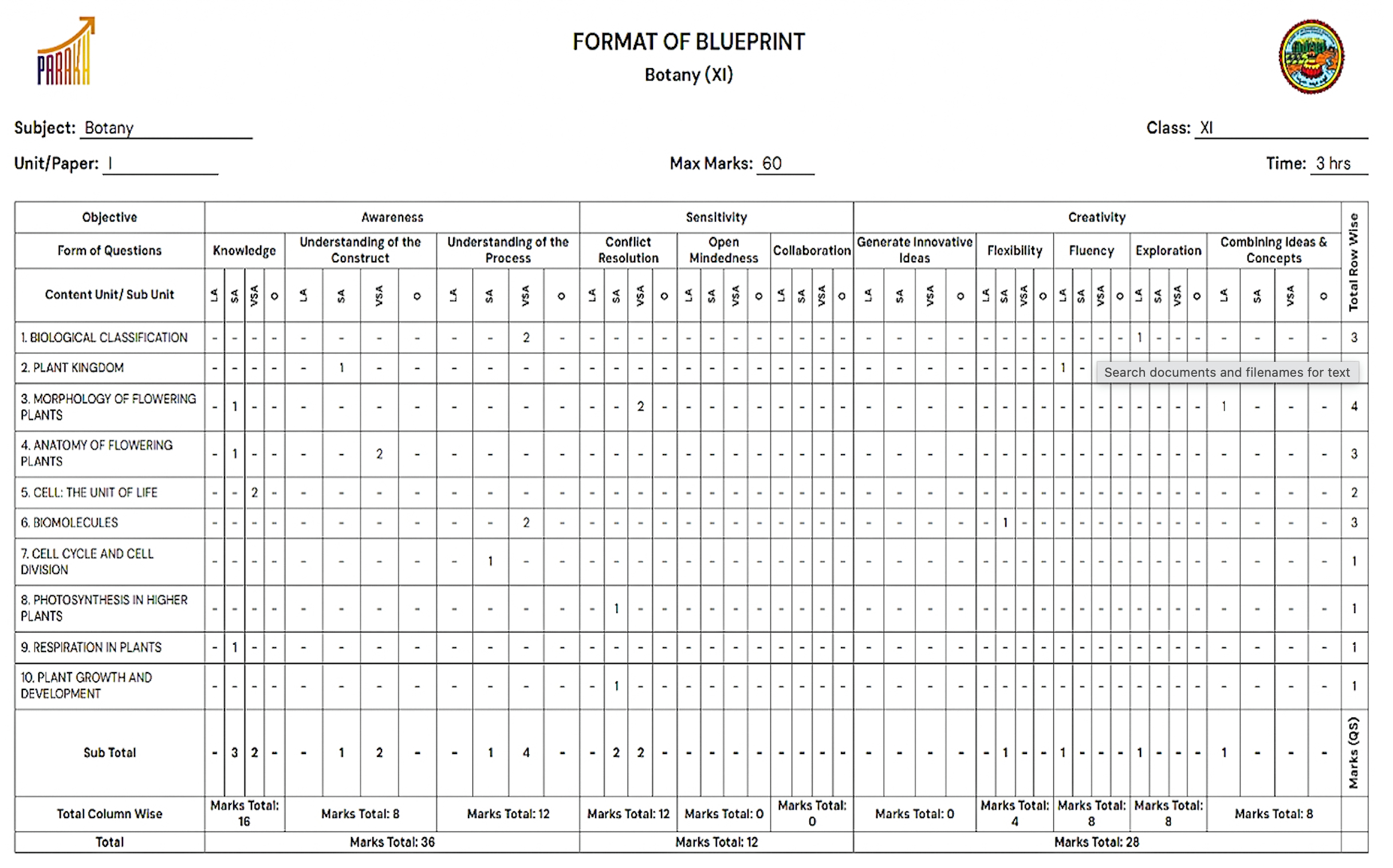
Create structured blueprints specifying sections, chapter-wise weightage, ability-to-question mapping, mandatory vs optional questions, marks distribution, and language-specific instructions. The system validates that sufficient questions exist in the bank.
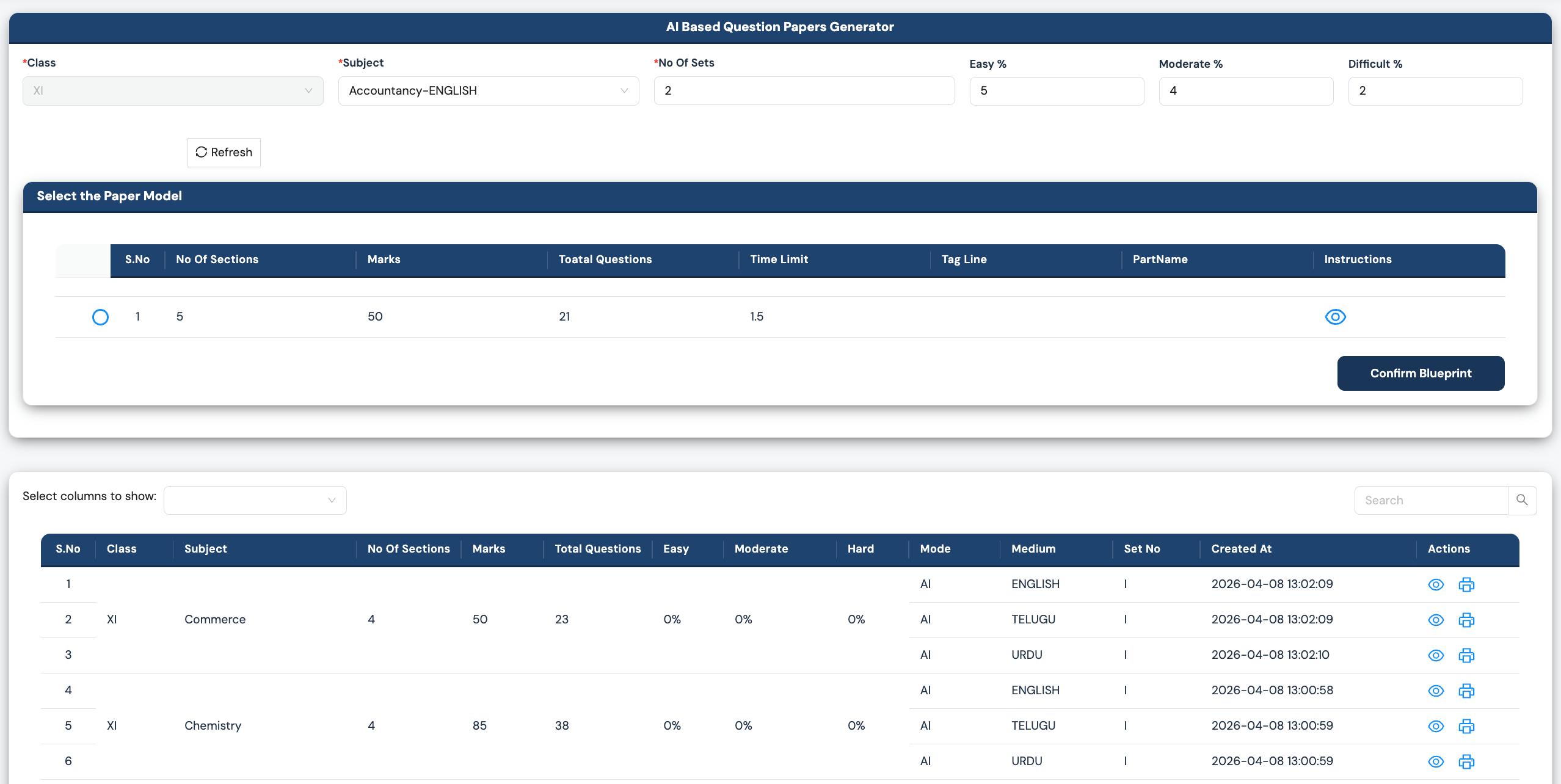
Select a blueprint, define the Easy / Moderate / Difficult distribution percentages, choose the number of sets, and generate. The AI engine picks questions satisfying the blueprint's ability mapping, chapter coverage, and difficulty balance.
For paper setters who want hands-on control: select a blueprint, then pick questions chapter-by-chapter. The system shows available questions per section, lets you review each before selection, and validates picks against blueprint requirements.
For boards running combined papers, merge Botany + Zoology into Biology, Commerce + Accountancy into a single paper. Define the part ordering, and the system generates a unified paper with combined instructions and correct numbering across all language versions.
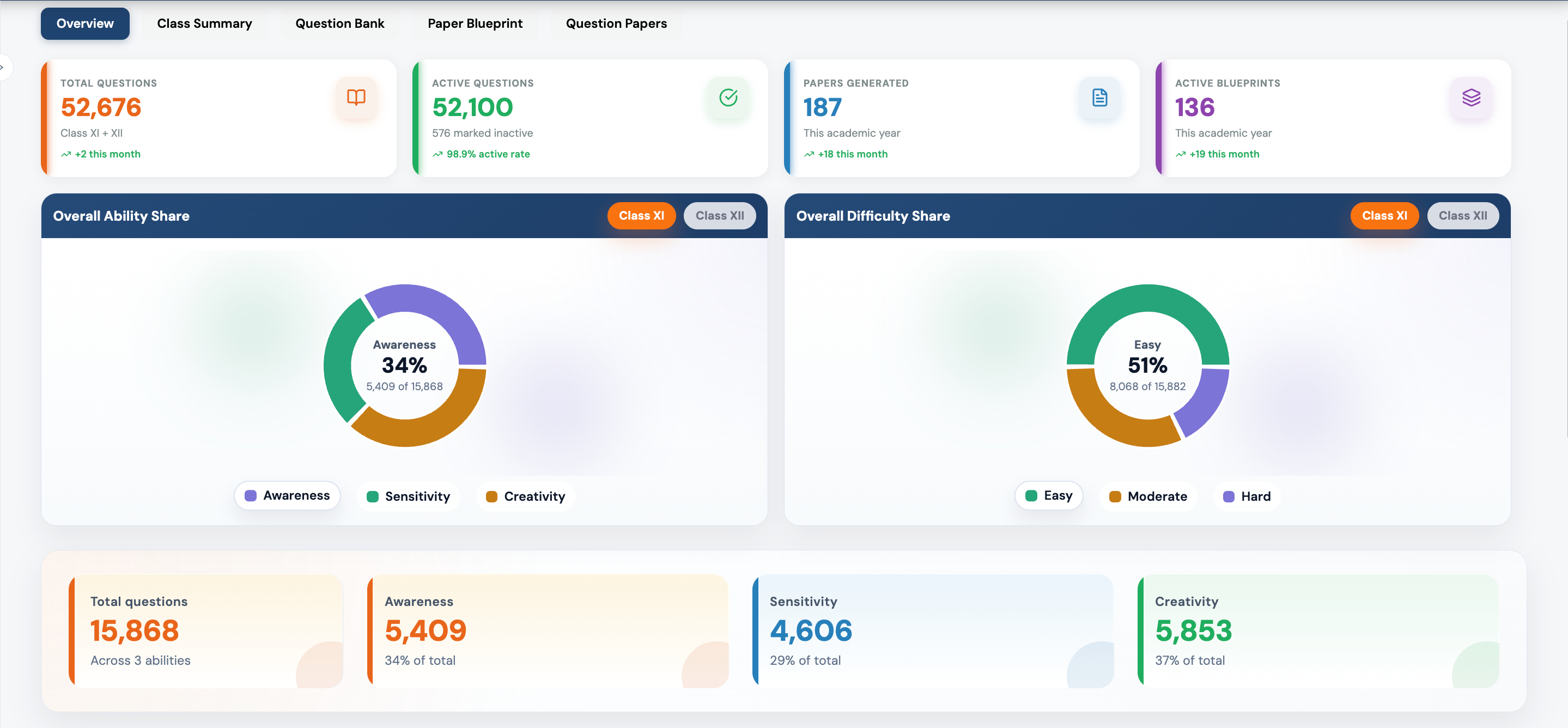
Monitor everything: question distribution by class, subject, language, and difficulty; Class XI vs XII comparisons; AI vs Manual paper generation trends; blueprint usage tracking; recent paper history with status; and user activity metrics.
A streamlined five-stage process from user setup to secure paper printing.
Admin assigns subject-specific logins with role-based access
Add competency-mapped multilingual questions
Structure sections, chapters, abilities, marks
AI or Manual — balanced papers in all languages
Print directly — zero database storage, zero leak risk
Watch how state boards build question banks, design blueprints, and generate secure competency-mapped papers — all in one platform.
Generate the same question paper simultaneously across all configured languages — each with its own instructions, content, and formatting. Supporting India's linguistic diversity for true assessment equivalence.
Every layer of the system protects question paper integrity.
Papers are printed directly without database storage — eliminating digital leak risks entirely.
Admin, Question Bank Editor, and Paper Setter — each user sees only what they are authorised to access.
Each paper setter accesses only their assigned subject — complete isolation at the login level.
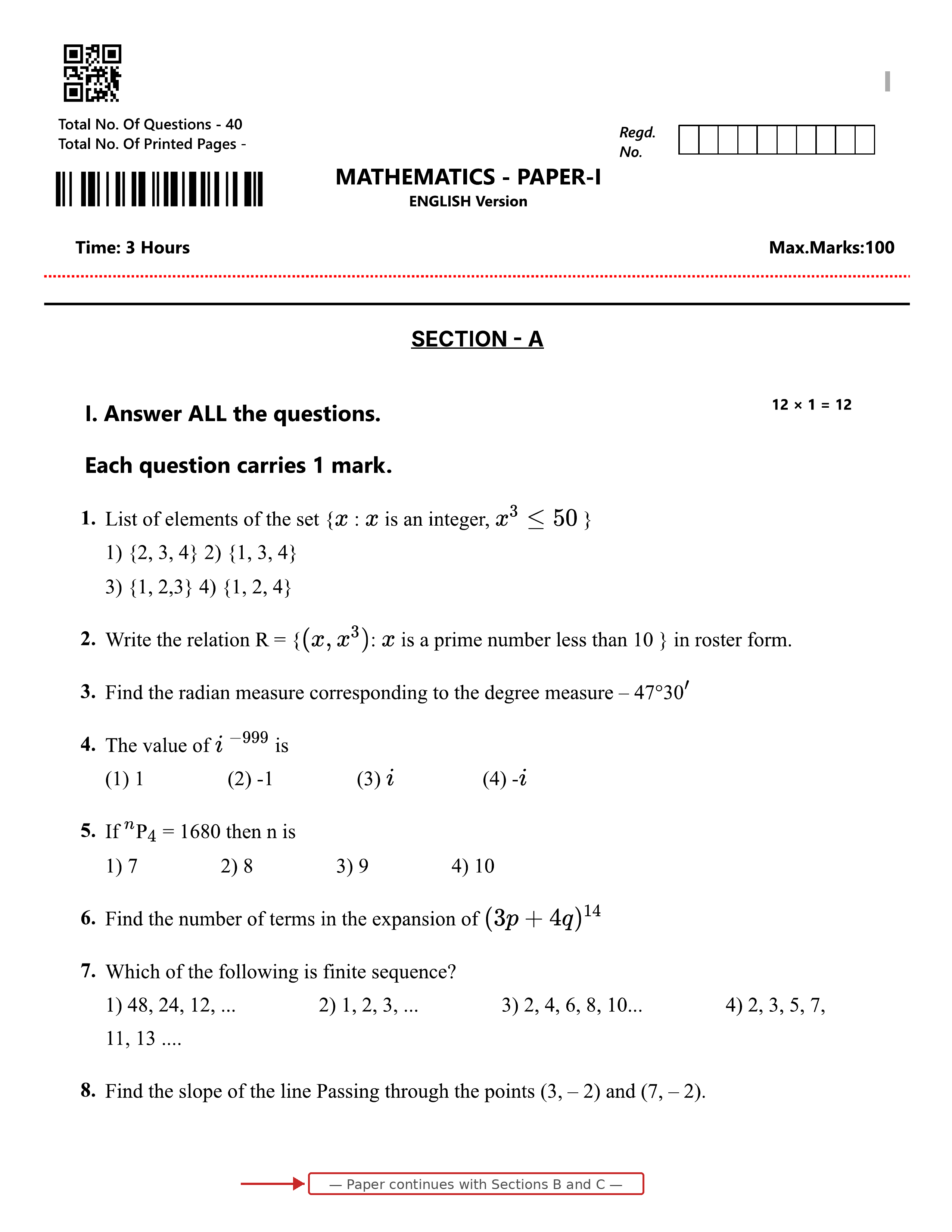
Every generated paper follows a standardized format with QR code, registration fields, section-wise instructions, and proper question numbering — ready for secure printing.
Yes. Every feature maps directly to the 7-step framework — from Assessment Design (Step 1) through Moderation (Step 7). The system enforces ability mapping (Awareness, Sensitivity, Creativity), difficulty classification, blueprint validation, and competency codes at every stage.
Absolutely. PARAKH ITMS is fully configurable — you can add your board's subjects, chapters, languages, and blueprint structures. The AP Board of Intermediate Education currently runs it with 20+ subjects across 16 languages.
Currently English, Telugu, Hindi, Bengali, Tamil, Kannada, Malayalam, Marathi, Gujarati, Odia, Punjabi, Assamese, Konkani, Meitei, Mizo, and Nepali. Additional languages can be configured during deployment.
Secure Print mode generates the paper directly in the browser and sends it to the printer without ever saving it to the database. Once printed, no digital copy exists in the system. This eliminates the primary vector for question paper leaks.
Yes. AI generation auto-assembles papers based on difficulty distribution and blueprint rules. Manual generation gives paper setters full control to pick individual questions chapter-by-chapter, with the system validating against the blueprint in real-time.
Both options are available — cloud-hosted SaaS solution or on-premise installation within your board's data centre. We recommend discussing your security requirements during the demo.
Schedule a live walkthrough of PARAKH ITMS with your team. We'll show you how the system maps to your board's specific needs.
"This document is a comprehensive resource designed to address the pressing need for standardised and equitable assessment practices across school boards in India. Through a meticulously designed seven-step process — and a strong emphasis on fairness, inclusivity, and competency-based assessment — it provides educators, administrators, and policymakers with actionable insights to transform assessment practices and pave the way for a future-ready education system aligned with NEP 2020.
"
Join the growing number of boards adopting standardized, competency-based question paper generation.